About Santiago Bernabéu
The Santiago Bernabéu stands on the Paseo de la Castellana in Madrid’s Chamartín district. Real Madrid opened it on 14 December 1947 with a friendly against Os Belenenses, and it was first known simply as the Estadio Real Madrid Club de Fútbol, or informally the new Chamartín. In 1955 it was renamed after Santiago Bernabéu, the club’s president.
It has been enlarged and rebuilt several times. Work in 1982 for the World Cup roofed most of the stands and put two video screens behind the goals, reportedly among the first in any stadium. In the 1990s a third tier was added and the roof was raised above it, and in 2001–2006 the east stand was expanded and given a new facade. The ground has hosted four European Cup and Champions League finals (1957, 1969, 1980 and 2010), the 1964 European Nations’ Cup final and the 1982 World Cup final, in which Italy beat West Germany 3–1.
The largest rebuild began in June 2019. The design by the Spanish studios L35 and Ribas & Ribas with the German firm GMP Architekten keeps the old footprint but wraps the stadium in a louvred steel facade and puts a roof over every seat. Part of that roof retracts, and the grass pitch can be slid away into an underground store so the arena can be used for concerts and other events. The first match in the renovated stadium was against Getafe on 2 September 2023, and a 360° video scoreboard running round the pitch under the roof was switched on in April 2024.
Cost and capacity figures for the rebuild vary between sources, from about €1.2 billion to about €1.76 billion for the cost, and from roughly 78,000 to more than 83,000 seats for the capacity. The club has not published a definitive number.
The diorama
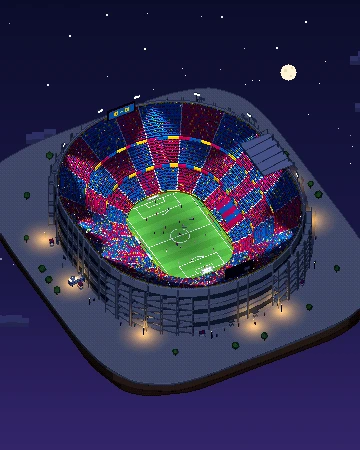
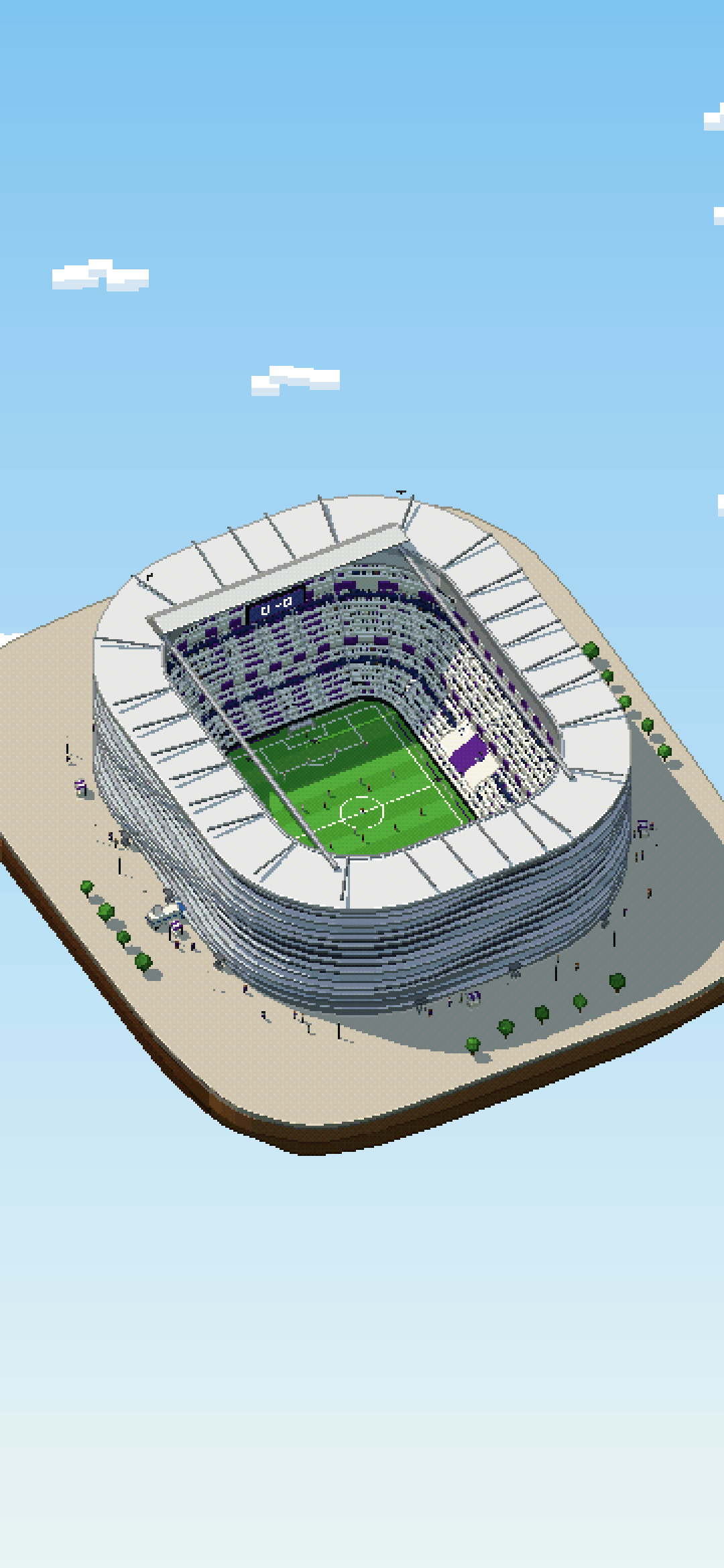
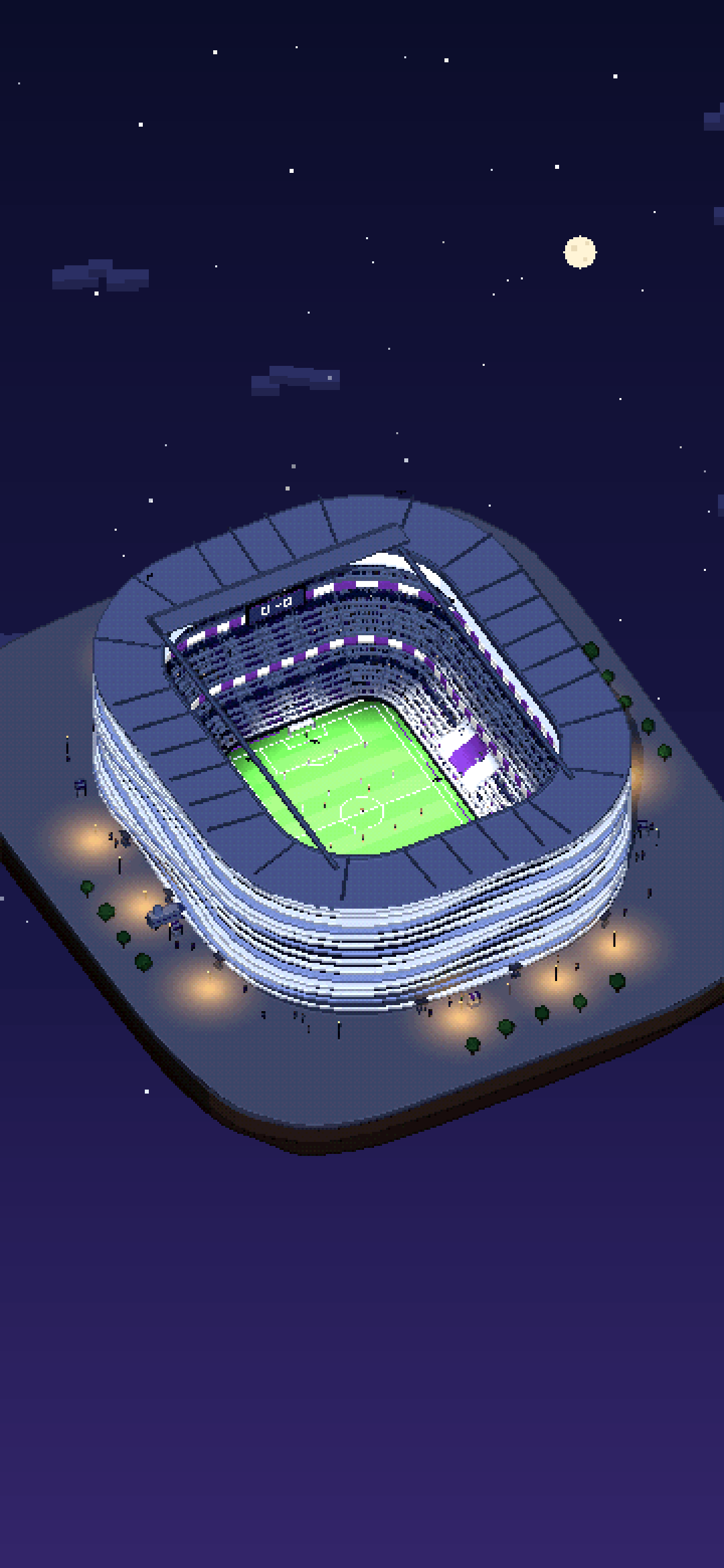
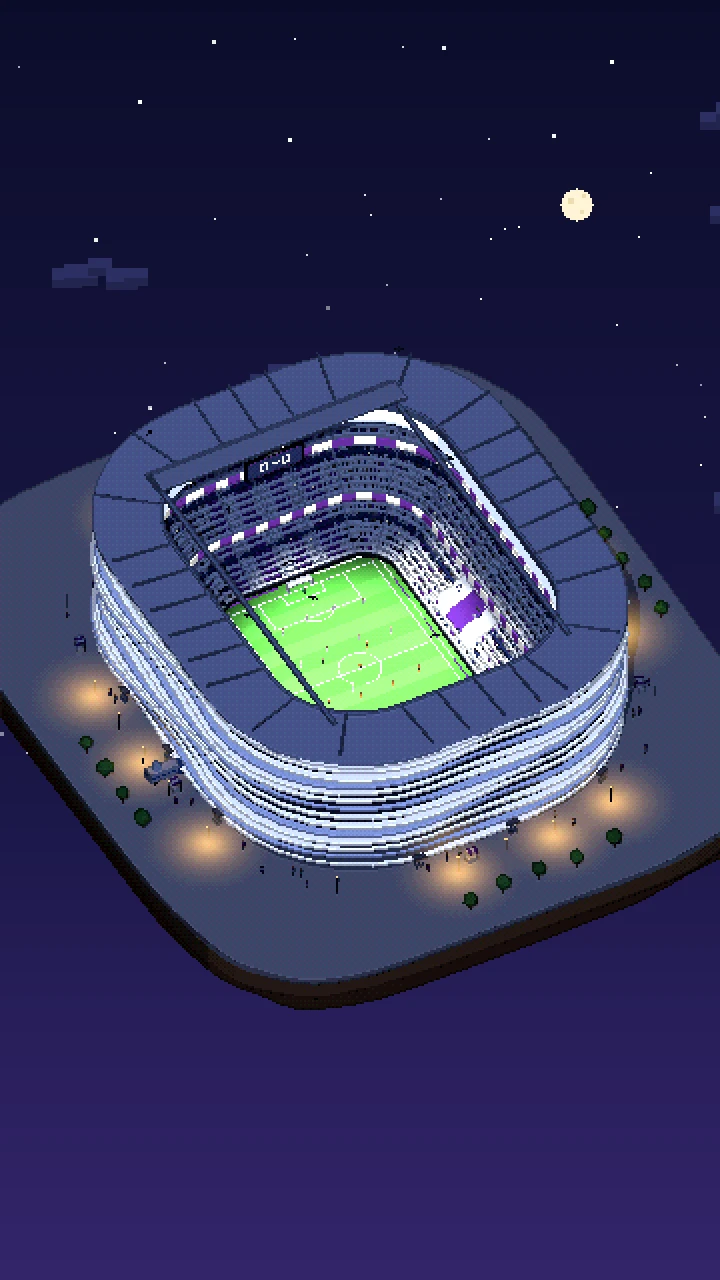
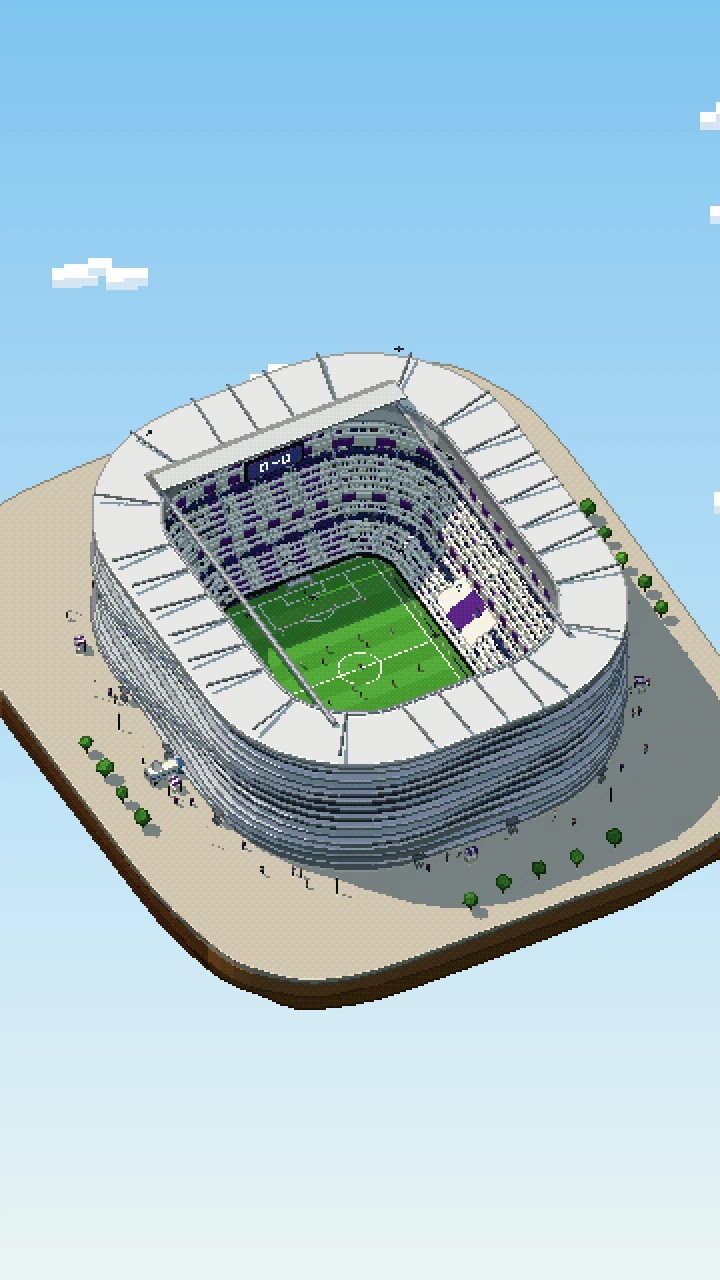
The diorama puts the rebuilt Bernabéu on a floating island, built in Three.js and rendered as pixel art: a low-resolution picture with dark outlines and a small palette, scaled up without smoothing. The scene uses 1 unit for every 2.5 metres and a full-size 105 × 68 m pitch. The bowl is a tall, steep rectangle with rounded corners and three tiers of white seats with a little purple, wrapped in horizontal silver ribbons whose depth waves round the building and glows white-blue at night. A roof covers every stand, and a bright video ring hangs under its inner edge. The retractable roof is shown open, with its rails across the opening and the closed panels stacked over one end.
A match plays on a loop of 15 seconds. Light changes from day to dusk to a floodlit night, and a goal is scored every cycle: the ball crosses the line, the scoreboards on both ends change from 0-0 to GOL! and then 1-0, the crowd jumps, and confetti rises from the stands. The home side plays in all white against an orange away kit. One end holds a white and purple striped tifo, a giant white and purple flag passes over the crowd on the far side, and phone lights come on in the stands at night. Outside, fans in white and purple walk the forecourt among street stalls, with a flock of birds overhead. Only club colours are used: no crests or sponsor names.
Things to spot
- The silver steel ribbons glowing blue-white at night
- The retractable roof panels stacked over one end
- The video ring under the roof’s inner edge
- The white and purple striped tifo and the giant flag on the far stand
- Confetti and the whole crowd jumping after the goal
What we simplified
- The facade is drawn as stacked horizontal ribbons of varying depth, not the real louvre pattern.
- The retractable roof is a simple set of rails and stacked panels. The real roof is part fixed and part retractable, and its geometry is different.
- The pitch sits on the ground. The real retractable pitch is stored in an underground structure and is not shown.
- The seating is a plain white bowl with a few purple and navy seats, and the number of tiers, the stairs and the tunnel mouths are generic, not a map of the real seating.
- The crowd, the players, the tifo and the flag are invented for the animation, and the bowl is scaled down: it does not reproduce the real capacity.
Questions
When did the Santiago Bernabéu open?
The Santiago Bernabéu opened on 14 December 1947 with a friendly against Os Belenenses. Its first league match, against Athletic Club, followed on 28 December 1947. It was renamed after club president Santiago Bernabéu in 1955.
What is the capacity of the Santiago Bernabéu?
Real Madrid has not published an exact figure for the rebuilt stadium. Sources give roughly 78,000 to 83,000: StadiumDB uses 78,297 from a World Cup bid document, and La Liga has listed 83,186.
What changed in the 2019–2024 renovation?
The stadium got a louvred steel facade, a roof over all seats with a retractable section, a 360° video scoreboard under the roof and a retractable pitch that can be stored underground. The design is by L35, Ribas & Ribas and GMP Architekten, and the first match in the new stadium was on 2 September 2023.
Which big finals has the Bernabéu hosted?
It has hosted the European Cup or Champions League final in 1957, 1969, 1980 and 2010, the 1964 European Nations’ Cup final, and the 1982 World Cup final, in which Italy beat West Germany 3–1.
How was this pixel-art diorama of the Santiago Bernabéu made?
It is a real-time Three.js scene running on this page, drawn at a low resolution with dark outlines and a small palette, then scaled up without smoothing. A scripted match loops every 15 seconds with a goal each time. Press “Explore in 3D” to drag it round and switch between day, dusk and night.
Isometric maps of Madrid
Madrid also has an isometric pixel-art map made by the community: the whole city drawn tile by tile in the same SimCity-like style. See the map of Madrid →