About Golden Temple
Sri Harmandir Sahib, also called Darbar Sahib and known around the world as the Golden Temple, is the holiest gurdwara of Sikhism. Its story begins with the pool: Guru Ram Das, the fourth Sikh Guru, had the Amrit Sarovar dug around 1577, and the town that grew around it, first called Ramdaspur, became Amritsar, the “pool of nectar”.
His son and successor, Guru Arjan, built the temple in the middle of the pool and installed the Adi Granth, the Sikh scripture, there in 1604. He set the building lower than the ground around it, so that everyone steps down to enter, as a sign of humility, and gave it doors on all four sides, open to people of every caste and faith.
The temple was attacked several times. Ahmad Shah Durrani’s forces blew it up in 1762, and rebuilding began in 1764; the gateway, causeway and sanctum were finished in 1776. In the early nineteenth century Maharaja Ranjit Singh had the upper storeys and dome covered in gilded copper, which gave the temple its popular name. The gold was renewed in the late 1990s.
More than 100,000 people visit on a typical day. They cover their heads, leave their shoes, and walk clockwise along the white marble parikrama around the pool. Across the causeway from the temple stands the Akal Takht, founded by Guru Hargobind in 1606, and the temple’s langar, the free community kitchen, feeds everyone who comes, whatever their background.
The diorama
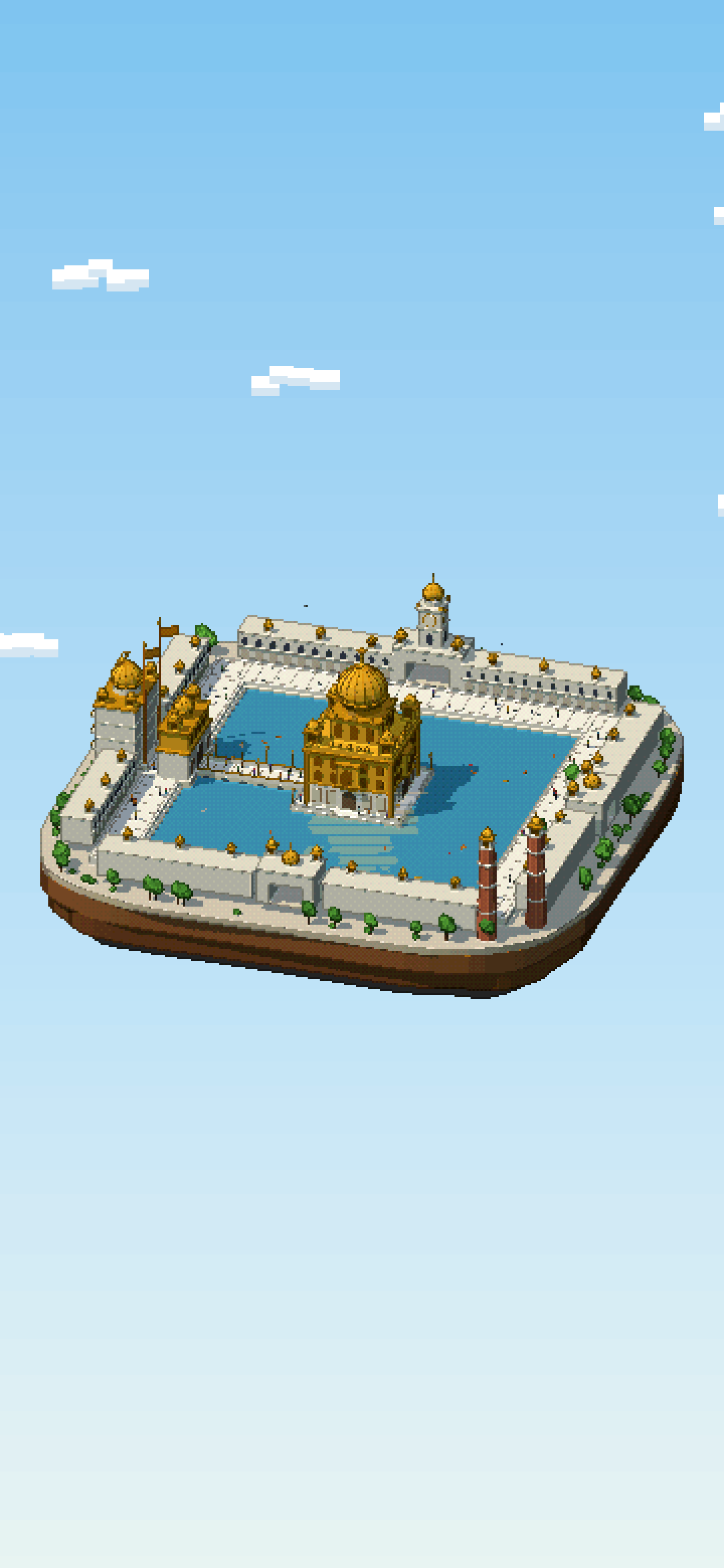
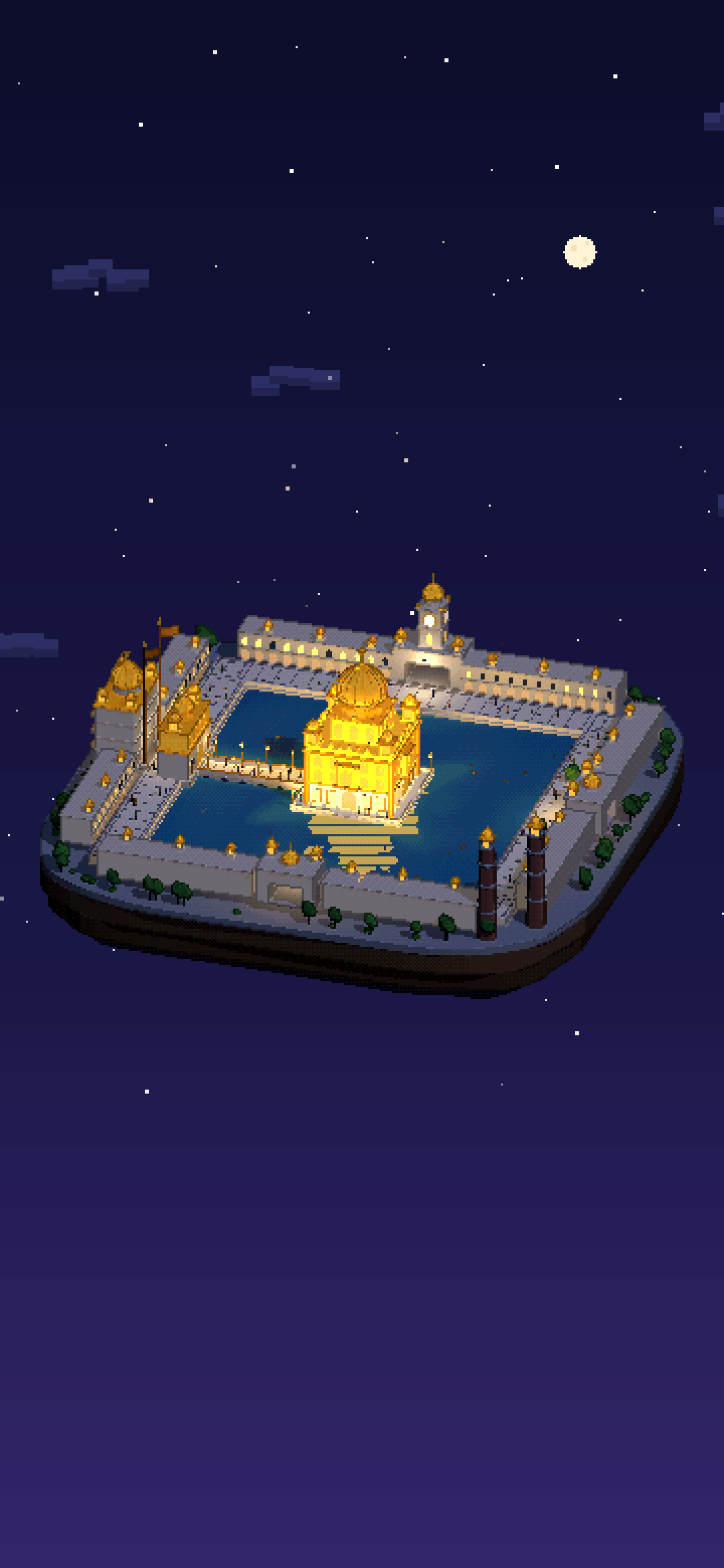
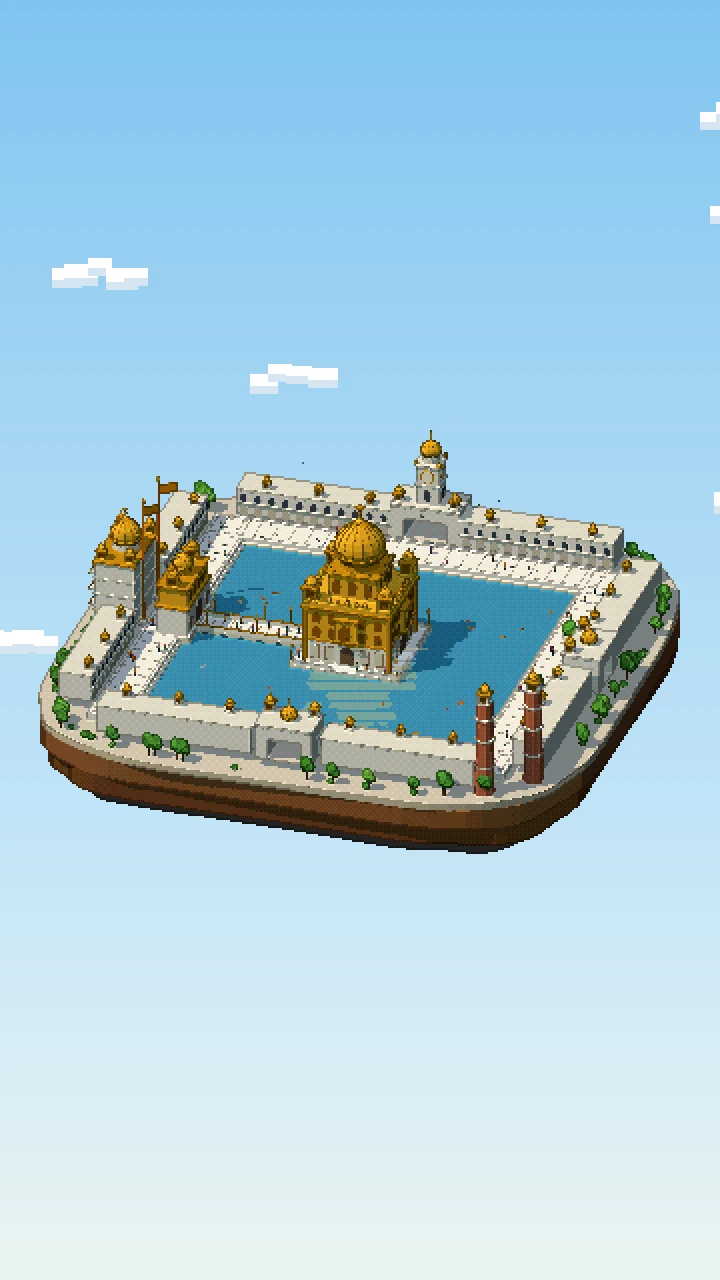
The temple sits on its marble platform in the middle of the pool: white marble walls below with a door on each side, gilded walls above with rows of arched niches, a parapet of small golden domes, four corner kiosks, the gilded upper storey and the fluted dome shaped like an inverted lotus. A marble causeway lined with golden lamps leads west to the two-storey Darshani Deori gateway.
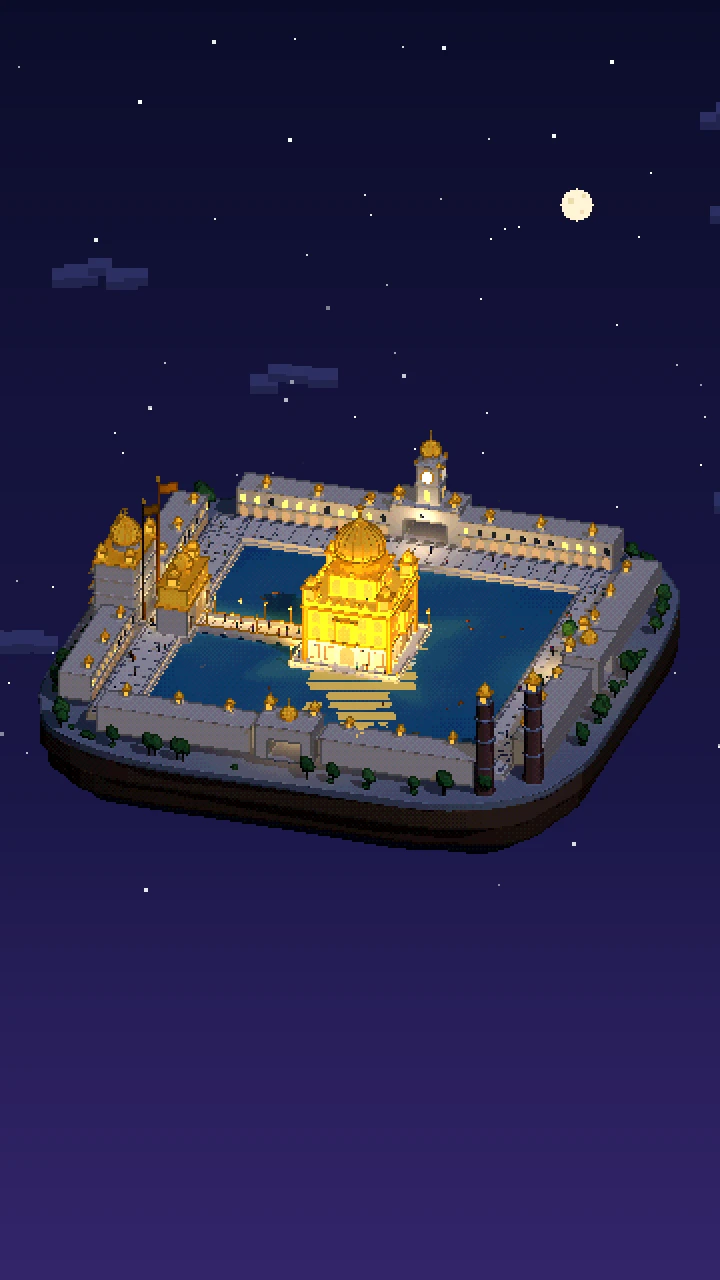
Around the pool runs the white marble walkway, with two-storey white buildings, a clock tower over one entrance, the Akal Takht with its gilded dome, two saffron Nishan Sahib flags and two tall brick watchtowers. Pilgrims in colourful turbans and headscarves walk clockwise around the water, koi swim in the pool and pigeons circle overhead. At night the temple glows gold and its reflection shimmers in the pool.
Things to spot
- Pilgrims walking clockwise around the pool
- Koi swimming in the Amrit Sarovar
- The two saffron flags in front of the Akal Takht
- Golden lamps along the causeway
- Pigeons circling and pecking on the marble
- The temple’s golden reflection in the water at night
What we simplified
- The temple is drawn a little larger than life, and the pool and causeway are much shorter than the real ones, so the whole complex fits on one island.
- The buildings around the pool are simplified into plain white rows, and only a few of the real entrances are shown.
- The marble inlay, the gilded panels and the interior are reduced to simple shapes.
Questions
Why is it called the Golden Temple?
In the early nineteenth century Maharaja Ranjit Singh had the upper part of the temple and its dome covered in gilded copper. Its proper name is Sri Harmandir Sahib, also called Darbar Sahib.
When was the Golden Temple built?
Guru Arjan built the temple in the middle of the Amrit Sarovar and installed the Adi Granth there in 1604. It was destroyed in 1762 and rebuilt from 1764, and the gilding was added in the early nineteenth century.
Can anyone visit the Golden Temple?
Yes. The temple has doors on all four sides to show that it is open to everyone. Visitors cover their heads, remove their shoes and walk clockwise around the pool, and the langar serves free meals to all.
What is the pool around the Golden Temple?
It is the Amrit Sarovar, the “pool of nectar” that gave Amritsar its name. It was dug under Guru Ram Das and finished around 1577, and a causeway about 60 metres long links the temple to the Darshani Deori gateway.
How was this pixel-art diorama of the Golden Temple made?
It is a real-time Three.js scene running on this page, drawn at 360 × 640 pixels with outlines and a small palette, then scaled up without smoothing. Press “Explore in 3D”, drag to turn it, and switch between day, dusk and night.