About Burj Khalifa
Burj Khalifa rises from the middle of Downtown Dubai, a district built from scratch in the 2000s around the tower, a lake and the Dubai Mall. Construction began in 2004 and the tower opened on 4 January 2010. At 828 metres it is the tallest building in the world by a wide margin. It was planned as Burj Dubai and renamed at the opening after Sheikh Khalifa bin Zayed Al Nahyan, then President of the United Arab Emirates.
The tower was designed by Adrian Smith at the Chicago office of Skidmore, Owings & Merrill. Its plan is a Y: three wings around a hexagonal central core, a shape said to be inspired by a desert flower, the Hymenocallis. The wings brace each other and the core, and as the tower rises they step back one after another in a spiral, so the building narrows towards the top and the wind never meets the same face for long.
Above the highest floors the concrete gives way to a steel spire of more than 200 metres, built inside the tower and jacked up into place. The facade is reflective glass with vertical stainless steel fins, chosen to cope with the desert heat. The building holds offices, apartments and a hotel, and has observation decks high up the tower.
At its foot lies Burj Lake with the Dubai Fountain, whose jets are choreographed to music every evening, with Souk Al Bahar and its wind towers on one shore and the Dubai Mall on another. At night the facade itself becomes a screen, with LED shows running up the full height of the tower.
The diorama
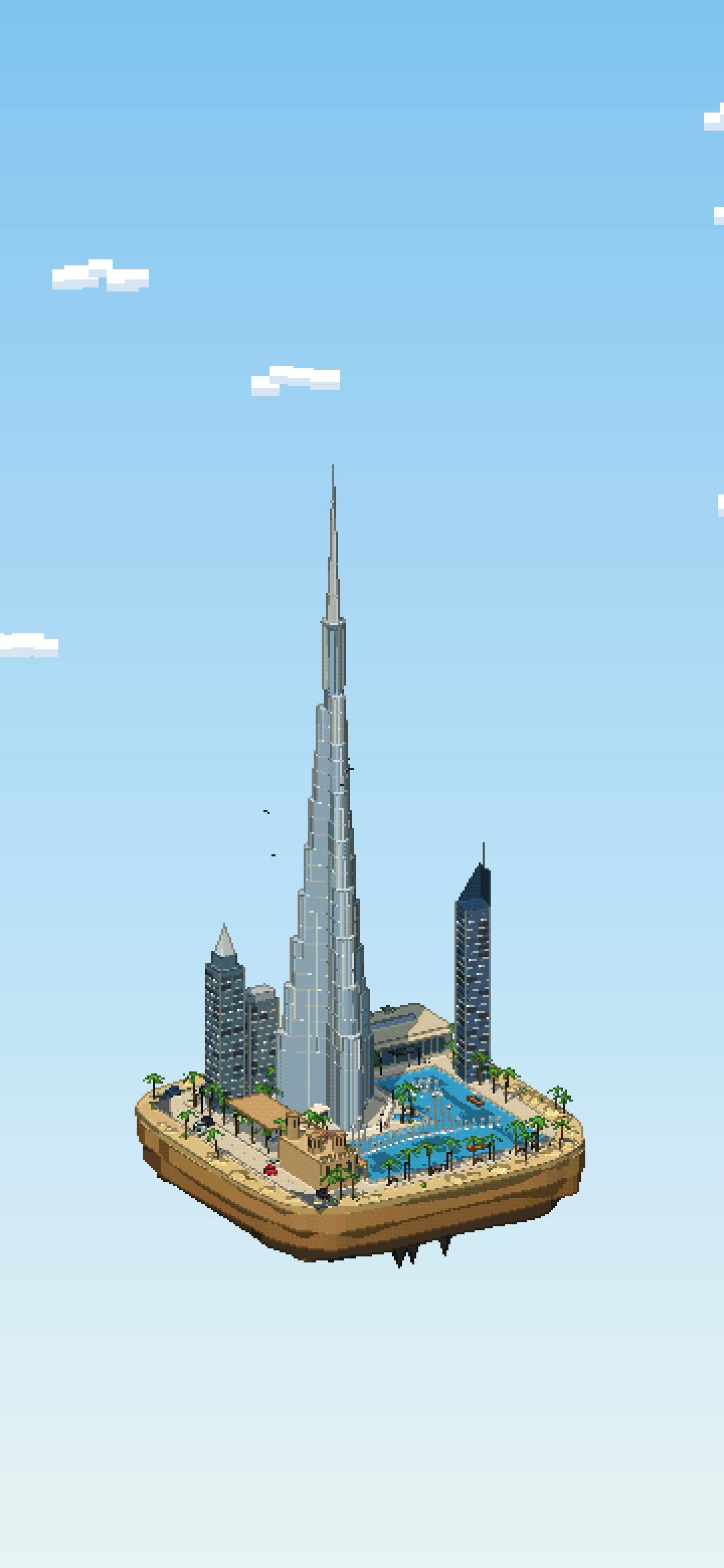
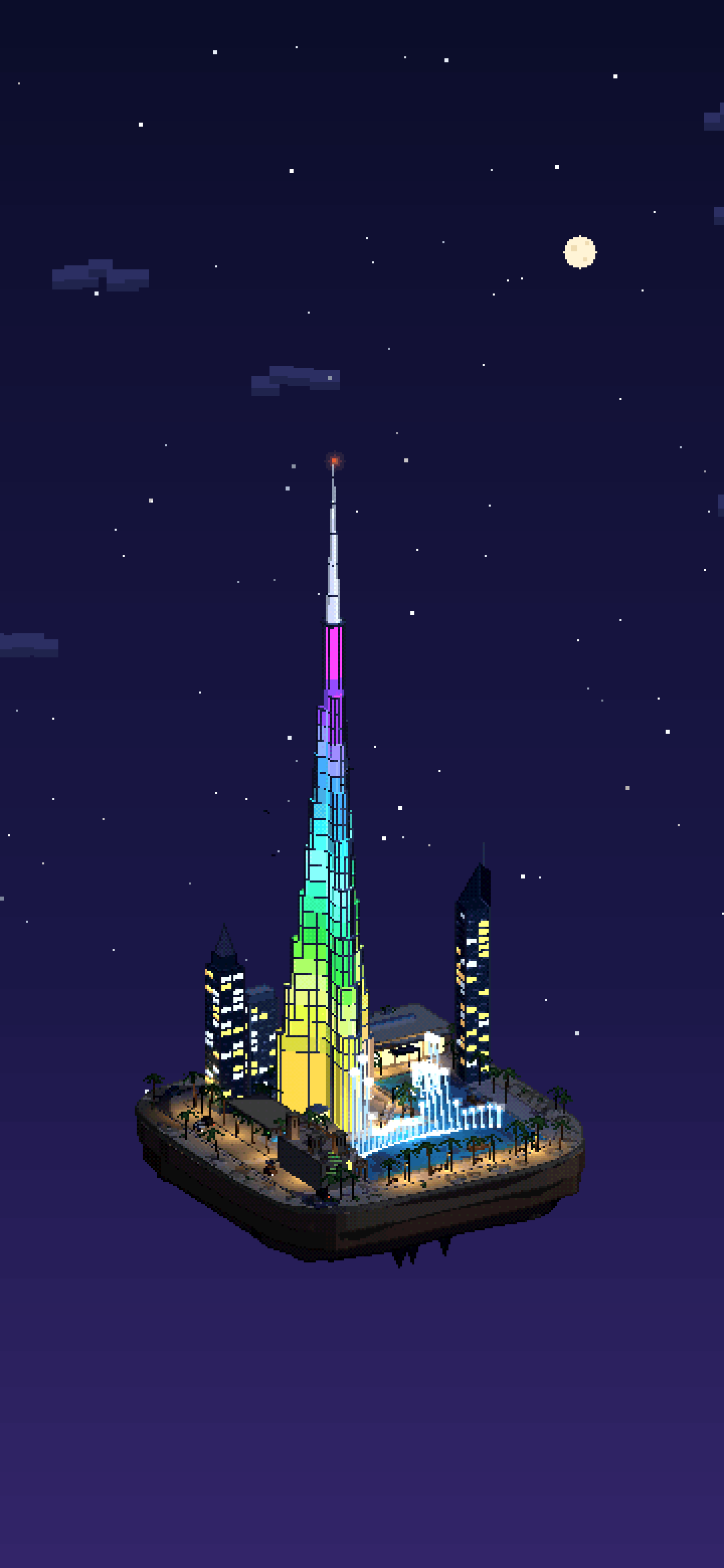
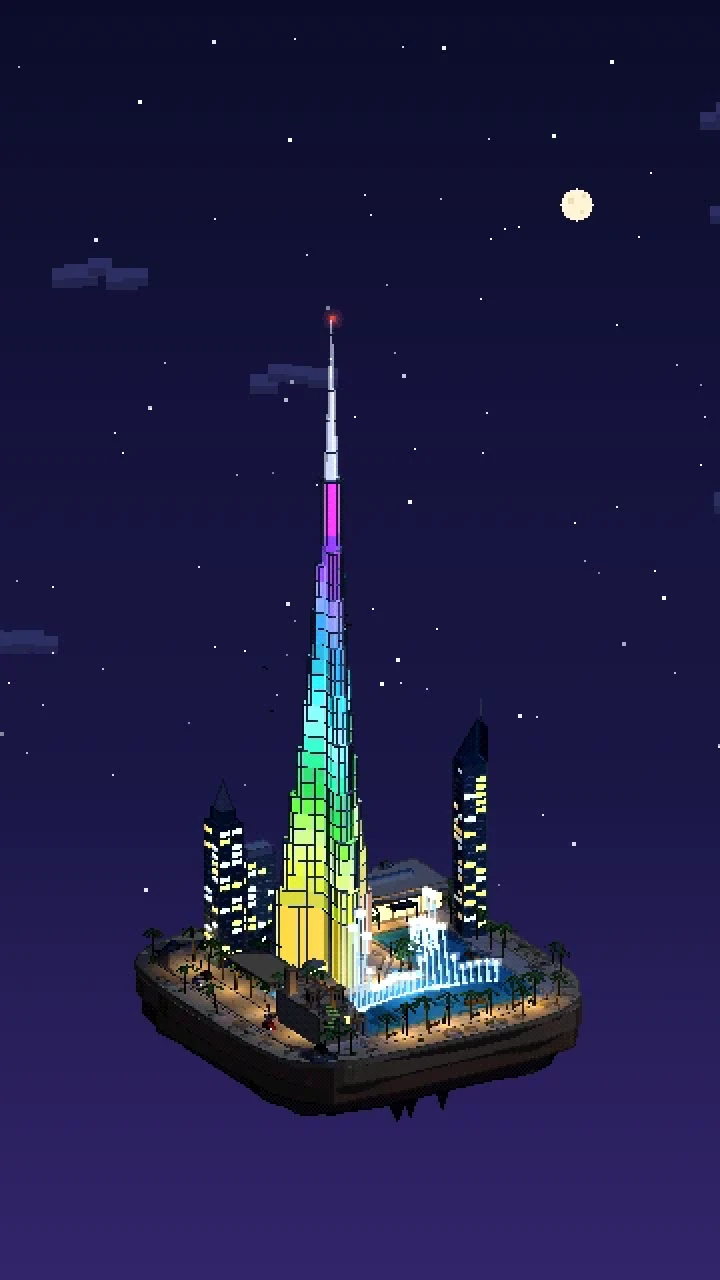
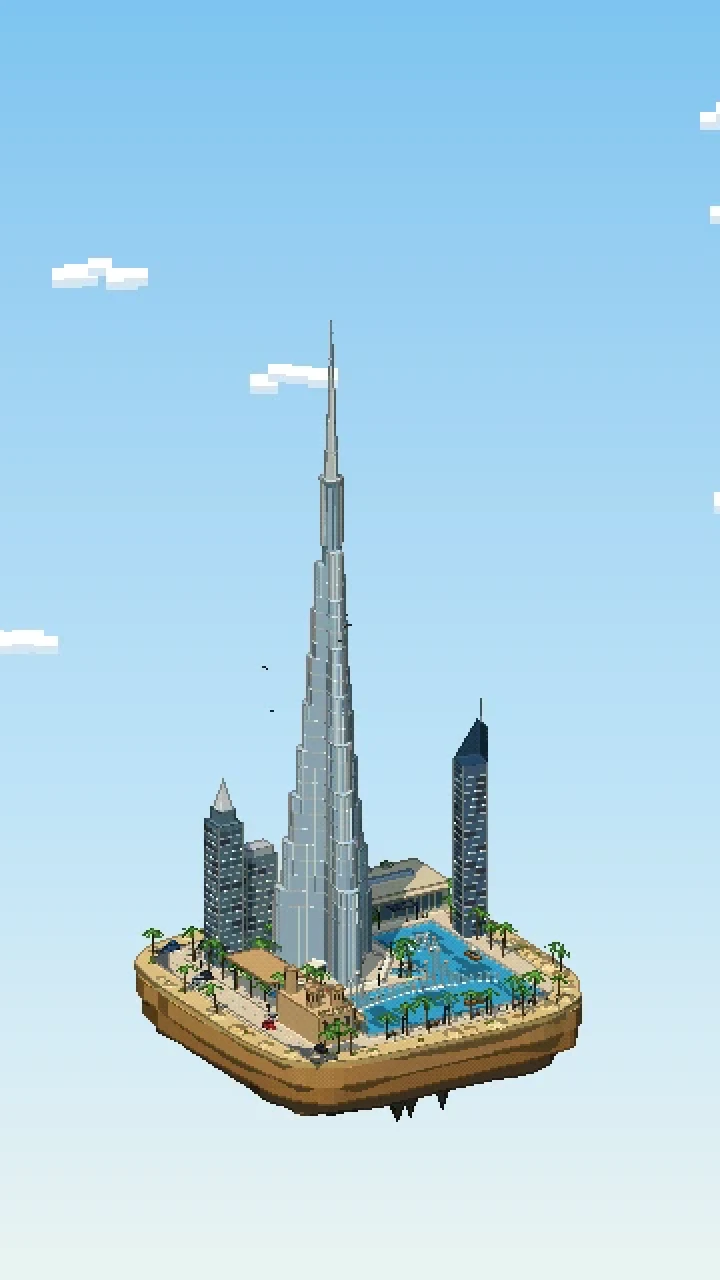
The tower in the diorama is built from its real plan: three wings round a hexagonal core, each wing stepping back in turn so the setbacks spiral round the tower, with fins along the flanks and floor bands at every step. Near the top the core rises clear of the wings inside a cage of fins, and the spire telescopes to a needle with a red beacon. The tower is drawn at one scale and the city around it at a friendlier, larger one, so people, palms and cars still read next to it.
Around it are the hexagonal podium with Y-shaped pools and lawns, Burj Lake with the fountain, Souk Al Bahar with its arcade, wind towers and rooftop umbrellas, the glass front of the Dubai Mall, the Address Downtown with its sloping top, a few more glass towers, the boulevard with traffic and a rim of desert sand and palms. At night the facade runs an LED show, cycling through a rainbow spiral, a gold ring shooting up a blue tower and a rippling UAE flag, while the fountain plays a glowing show and the spire beacon blinks red.
Things to spot
- Two abras crossing Burj Lake
- The fountain changing programme every few seconds
- Wind towers on Souk Al Bahar
- The UAE flag in the LED show at night
- The red beacon blinking on the spire
- Cars with head and tail lights on the boulevard
What we simplified
- The tower has 8 setbacks per wing instead of the real 27 overall, and the Dubai Fountain, Souk Al Bahar, the Dubai Mall and the Address Downtown are pulled in close and drawn smaller.
- The sand and dunes around the edge of the island stand in for the desert; Downtown Dubai today is surrounded by city, not sand.
Questions
How tall is the Burj Khalifa?
The Burj Khalifa is 828 metres tall, the tallest building in the world. It has 163 floors, topped by a steel spire of more than 200 metres.
When was the Burj Khalifa built?
Construction began in 2004 and the tower opened on 4 January 2010. It was planned as Burj Dubai and renamed at the opening after Sheikh Khalifa bin Zayed Al Nahyan.
Who designed the Burj Khalifa?
Adrian Smith designed it at the Chicago office of Skidmore, Owings & Merrill, for the developer Emaar Properties. Its Y-shaped plan, three wings around a hexagonal core, is said to be inspired by the desert flower Hymenocallis.
Why is the Burj Khalifa shaped like that?
The three wings brace each other and the core, and they step back one after another in a spiral as the tower rises. That way the building narrows towards the top and the wind never meets the same face for long.
How was this pixel-art diorama of the Burj Khalifa made?
It is a real-time Three.js scene running on this page, drawn at 360 × 640 pixels with outlines and a small palette, then scaled up without smoothing. Press “Explore in 3D”, drag to turn it, and switch between day, dusk and night.