About St. Basil’s Cathedral
St. Basil’s was built between 1555 and 1561 on the orders of Ivan the Terrible to mark the capture of Kazan from the Tatars. Its official name is the Cathedral of the Intercession on the Moat, after the moat that then ran along the Kremlin wall. The everyday name comes from Basil the Blessed, a holy fool popular with Muscovites, who was buried here and whose chapel was added in 1588.
The cathedral is not one church but nine, set on a shared raised base. Around the central Church of the Intercession, with its tall tent roof, stand four large churches on the main axes and four smaller ones on the diagonals, each crowned with its own drum and onion dome. A covered gallery that once was open links them all. Inside, the spaces are narrow and tall, painted with flowers and patterns.
At first the building was mostly red brick and white stone. The bright colours it is known for came later, in the 17th and 18th centuries, when the domes were given their patterns of stripes, spirals and facets, every one different. A free-standing bell tower was rebuilt next to it in the 1680s. A well-known legend says Ivan had the architects blinded so they could never build anything as beautiful again, but there is no evidence for it.
The cathedral came through the Soviet years, when many of Moscow’s churches were pulled down, and has been a museum since the 1920s; since 1991 occasional services have been held there again. Together with the Kremlin and Red Square, it was listed as a UNESCO World Heritage Site in 1990.
The diorama
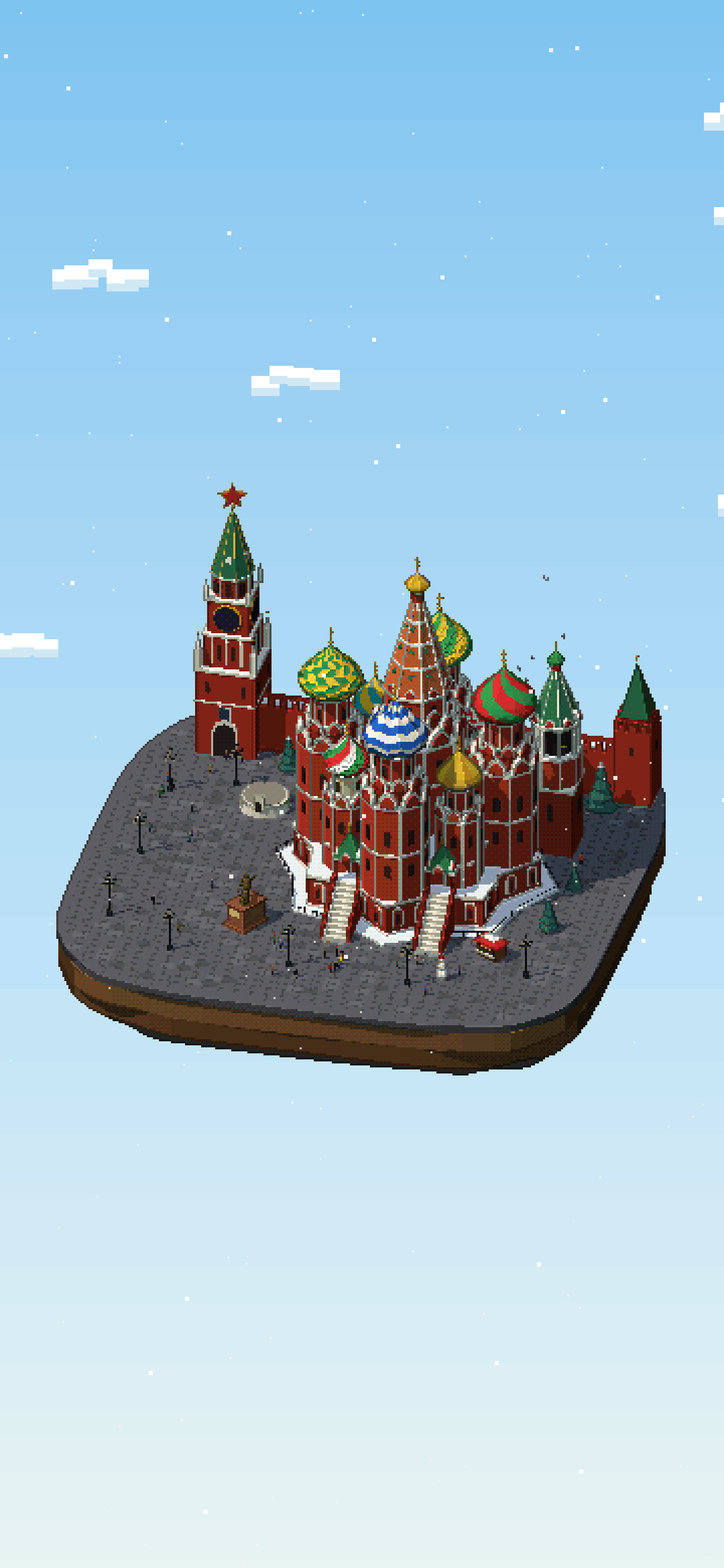
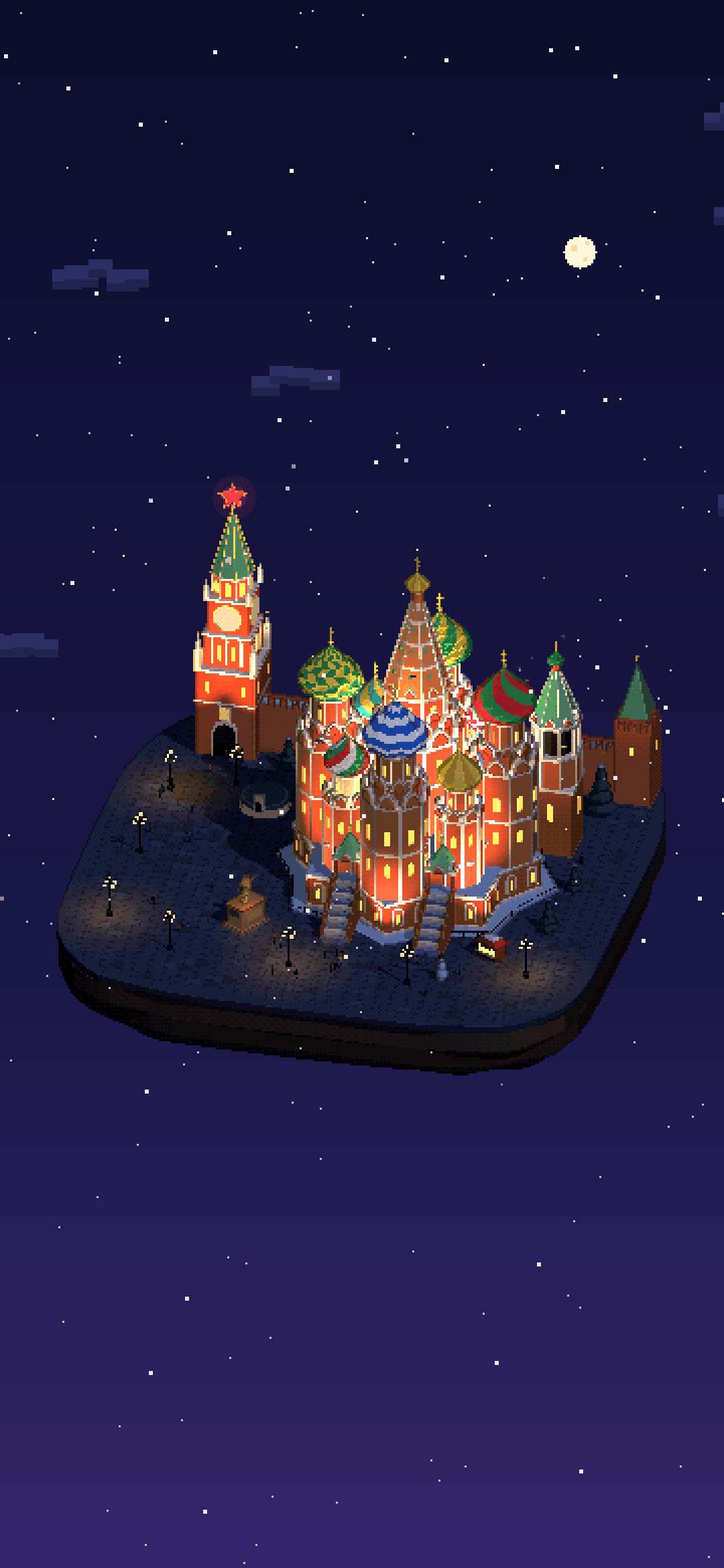
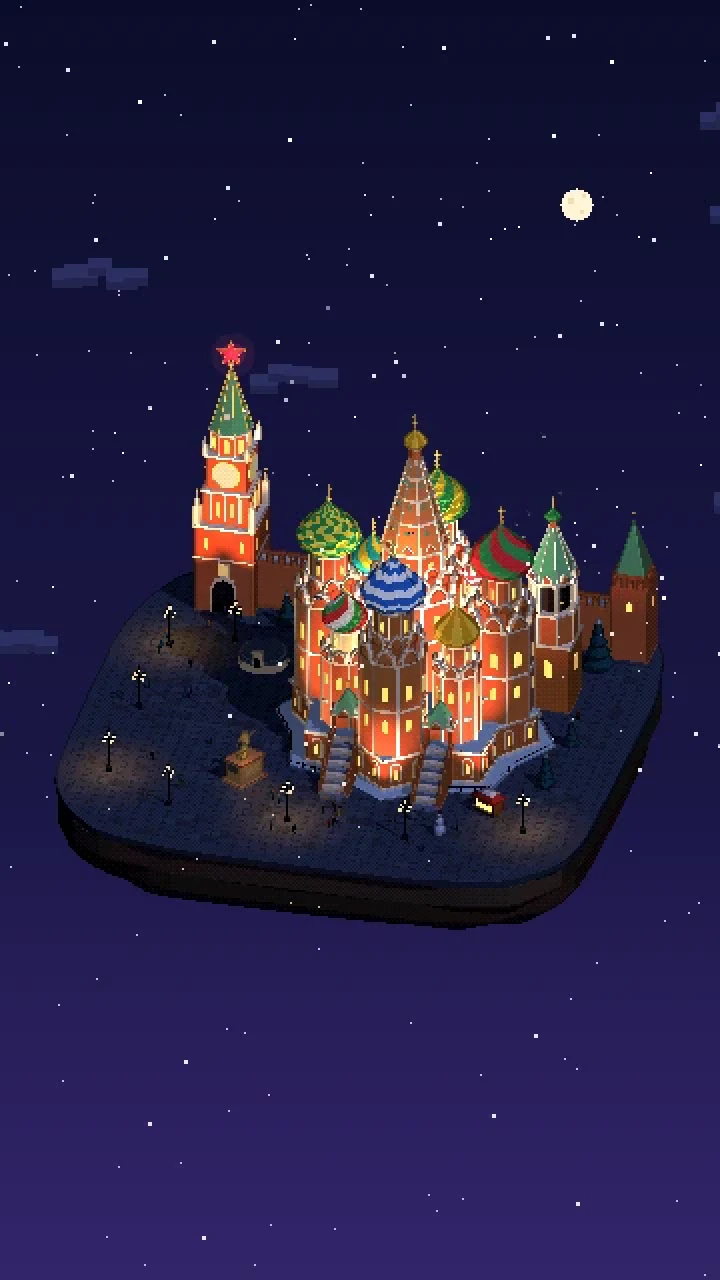
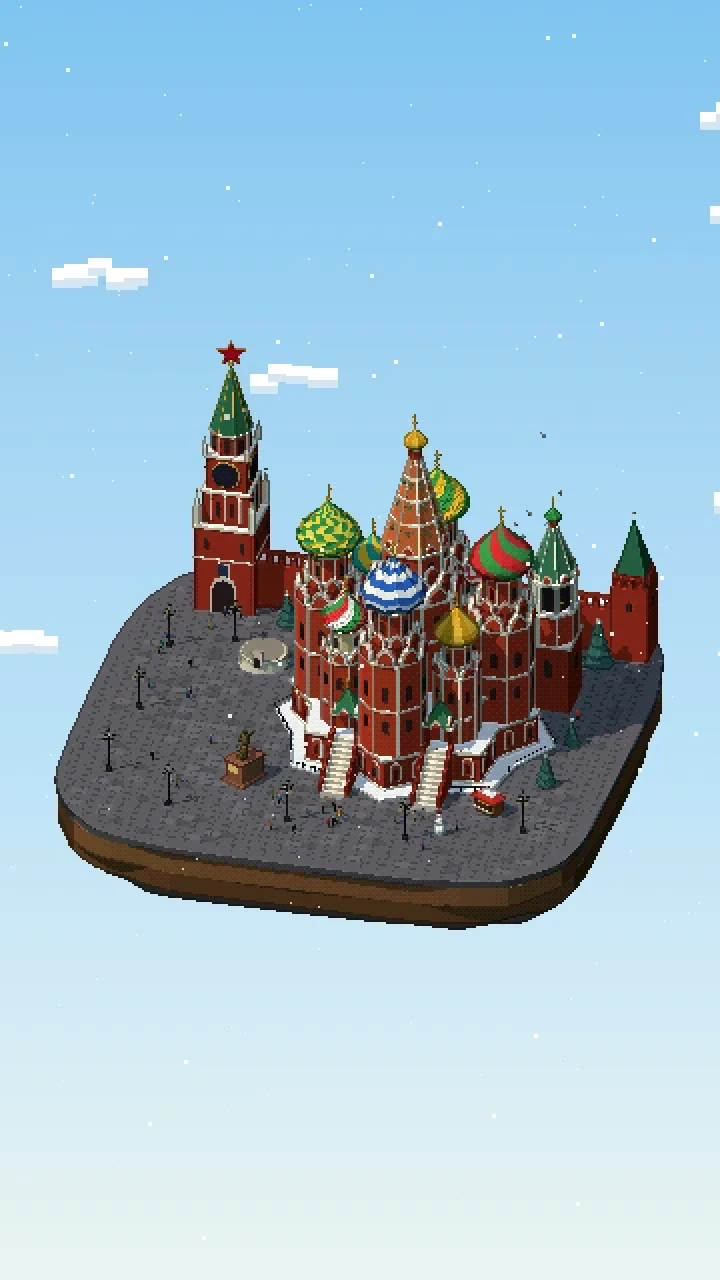
The diorama builds all nine churches on their raised base with arched niches: the central octagon with three tiers of kokoshnik gables under its tent roof and gold dome, and the eight side churches around it, each onion patterned differently in green and yellow spirals, blue and white zigzags, knobs and gold facets. The covered gallery, the tented stair porches at the front and the bell tower at the back corner are there too. The domes are a little enlarged so their patterns read at pixel scale.
Around it is a compressed corner of Red Square in winter: grey granite setts, the Kremlin wall with its swallowtail merlons, the Spasskaya Tower with its clock and ruby star, the little Tsar Tower, blue spruces, Lobnoye Mesto and the Minin and Pozharsky monument. Light snow falls all through the reel, and at night floodlights pick out the cathedral and the tower while the star glows red.
Things to spot
- A guide with her group, and tourists photographing the cathedral
- A snowman with a red hat
- A hot-drinks kiosk with a red roof
- Pigeons pecking in two little groups
- The ruby star on the Spasskaya Tower, glowing at night
What we simplified
- Red Square is squeezed: the Spasskaya Tower and the Kremlin wall stand much closer to the cathedral than in Moscow, and the tower is shorter than its real 71 m.
- The dome patterns follow the real colours and motifs but are simplified to a few repeating shapes.
Questions
When was St. Basil’s Cathedral built?
St. Basil’s Cathedral was built between 1555 and 1561 on the orders of Ivan the Terrible. It marked the capture of Kazan from the Tatars.
Why is it called St. Basil’s Cathedral?
The everyday name comes from Basil the Blessed, a holy fool popular with Muscovites who was buried there; his chapel was added in 1588. The official name is the Cathedral of the Intercession of the Most Holy Theotokos on the Moat.
Why are St. Basil’s domes so colourful?
The bright colours came later than the building: at first it was mostly red brick and white stone. In the 17th and 18th centuries the domes were given their patterns of stripes, spirals and facets, every one different.
Did Ivan the Terrible blind the architects of St. Basil’s?
There is no evidence for it. The story that Ivan had the architects blinded so they could never build anything as beautiful again is a legend.
How was this pixel-art diorama of St. Basil’s made?
It is a real-time Three.js scene on this page, drawn at 360 × 640 pixels with outlines and a small palette and scaled up without smoothing. All nine churches are built on their raised base, with the domes a little enlarged so their patterns read at pixel scale. Press “Explore in 3D”, drag to turn it, and switch between day, dusk and night.